Author: kensingtonedev

Kensington Invests in Jewlr

Technology-Driven Mass Customization Brand Disrupting Jewelry Industry

TORONTO, Feb. 10, 2022 /CNW/ – Kensington Private Equity Fund is pleased to announce the completion of a significant investment in Jewlr, a leading DTC ecommerce retailer that designs and manufactures personalized, made-to-order jewelry at scale.

Founded in 2009 and backed by early investor Brightspark Ventures, Jewlr has served more than a million customers across the United States, Canada, the United Kingdom and Australia. Jewlr’s mass-customization capability is driven by its proprietary technology platform developed by its wholly-owned Safyre Labs subsidiary.

Jewlr lets customers be the designer, offering custom-made personalized fine jewelry. The proprietary technology allows customers to create their unique piece of jewelry and visualize it in real-time 3D before they place their order. With thousands of designs available, customers can choose silver or gold, select from a vast inventory of gemstones, and personalize with meaningful engravings.

Based in Toronto, Canada, Jewlr manufactures all jewelry in their state-of-the-art facilities in Canada and the USA, ensuring that materials are ethically sourced and made in fair working conditions. It also allows direct control over production, so customers receive their made-to-order jewelry in days – not weeks. With no middlemen, jewelry is priced much lower than retail.

“Jewlr prides itself on delivering an exceptional customer experience. Our innovative user-friendly technology that customers interact with to personalize their jewelry really sets us apart. We custom manufacture and deliver in days, all backed by friendly and helpful customer service. Customer experience is our ultimate priority which drives our innovation.” says Daniel Stoppel, Jewlr CEO.

“We are impressed with the rapid growth in Jewlr’s business and profitability as the company continues to scale,” says Kensington Senior Managing Director, Rick Nathan, “Their technology-driven approach to mass customization through integrated sales and manufacturing systems creates a strong foundation for market leadership.”

“We are excited to welcome Kensington as an important new partner in our business,” said Stoppel. “We look forward to working together on the next stage of Jewlr’s growth and development.”

In connection with the transaction, Rick Nathan has joined the company’s board, alongside Kensington Managing Director, Liam Cheung.

About Jewlr
Jewlr is a leading direct-to-consumer retailer specializing in the design and manufacturing of personalized jewelry. Founded in 2009 by technology entrepreneurs, Jewlr has transformed the jewelry shopping experience by using proprietary technology to give customers the ability to create and instantly preview custom jewelry. Every Jewlr item is then made to order using 3D printing and traditional hand crafting to deliver high quality personalized jewelry in just a few days. www.jewlr.com

About Safyre Labs
Based in Toronto, Canada, Safyre Labs is an ecommerce and ERP platform, designed to manage the selling and manufacturing of custom made products. The scalable Safyre platform hosts two DTC ecommerce brands, Jewlr and Lee Fiori, to offer customers an innovative personalized jewelry experience.  Safyre Labs is a wholly-owned subsidiary of Jewlr.  www.safyrelabs.com

About Kensington Capital Partners
Founded in 1996, Kensington Capital Partners Limited is an employee-owned, high performing alternative investment firm with offices in Toronto, Vancouver, and Calgary. Kensington’s mission is to build great businesses, and in doing so, create top-performing investment solutions for its investors. Kensington has assets under management of $2.3 billion, managed across several active funds. https://kcpl.ca/

About Brightspark
Brightspark Ventures is one of Canada’s top performing venture capital firms, actively investing in exceptional entrepreneurs since 1999. They provide growth capital and expertise to disruptive, market-transforming Canadian tech companies in seed to growth stages. Since inception, Brightspark has invested across traditional VC Funds, and more recently under an investment model open to individual and non-institutional investors. www.brightspark.com

SOURCE Kensington Capital Partners Limited.

BC Tech Fund Managed by Kensington Capital Invests in Spare

An oversubscribed $18 million Series A round is going to help Spare further build out its mobility software platform for public transit, ride sharing, and other shared transportation.The Vancouver software startup hopes its platform will encourage better cooperation between different transportation providers, increased access to cost-efficient shared rides, and will see more people opt for collective transportation.

“Spare is building the operating system for the future of mobility.”

Inovia Capital led the funding round with participation from Kensington Capital, Link VC, Ramen VC, Ridge Ventures, TransLink Capital and Japan Airlines (as JAL Innovation Fund) and Nicola Wealth, among others.
The round closed on November 3, and, with the current round, Spare has raised $25 million to date. Spare is also backed by the likes of the Mitsubishi Corporation.

“Spare is building the operating system for the future of mobility,” said Todd Simpson, a partner at Inovia. “Its vision of how public and private transportation providers should be able to collaborate without technological impediments to offer a more positive and equitable shared transportation experience to people everywhere really resonated with us and we’re excited to see them grow.”

Simpson is joining Share’s board, something that Spare CEO Kristoffer Vik Hansen welcomes. Vik Hansen said Simpson brings a lot of experience in helping companies scale, something the start is definitely looking toward as its plans to grow from just over 50 people to double or triple that size by the end of 2022.

Spare’s platform includes data-driven transit planning, analytics dashboards, and a customer relationship management hub to help enable on-demand mobility services.

RELATED: Ontario, Michigan collaborating on advanced automotive and mobility technology

Spare’s hope is that by making transit operations more efficient, transportation providers can address such mobility challenges in today’s cities as first-and-last mile transportation, and transit deserts.

Vik Hansen noted that Inovia has been “pretty keen” on how to improve efficiency in transportation for some time. Inovia has funded travel app start-up Hopper, for example, as well as bus ticket reseller Busbud. One of the things Inovia wanted to add to its portfolio was a company with a strong thesis around a mobility operating system, which is what Spare offers, according to Vik Hansen.

Vik Hansen said that the pandemic showed that the scheduled, fixed-route transit model isn’t always the answer. He claimed that at the height of the pandemic Spare’s on-demand technology helped transit authorities maintain service as they rebuilt amid cutbacks on fixed routes because of declining ridership.

“People shouldn’t have to choose between convenience, availability and sustainability, “ Vik Hansen said. “By allowing riders to seamlessly transition from an on-demand shuttle to a fixed-route rapid bus to a pooled ride-sharing via one ecosystem that brings together multiple providers on the back-end, they can have all three.”

Spare’s customers number 80 across Canada, the United States, Europe, and Japan. In fact, in 2019, Prime Minister Justin Trudeau cited Spare and its Japanese investor Mitsubishi Corporation in a speech he gave about Canada’s closer collaboration with the Asian-Pacific country.

Trudeau noted Mitsubishi’s $5.8 million CAD investment in Spare, and that the two companies along with a third partner are testing a multi-year, AI-controlled-on-demand bus transit service in Fukuoka.

“With this collaboration, Spare and Mitsubishi Corporation will be well-positioned for significant growth in the multi-billion dollar market for next-generation, shared mobility services in Japan,” Trudeau said at the time.

RELATED: How COVID has re-routed Canada’s mobility future

Spare offers a few different approaches to transit. For instance, it uses a concept it’s dubbed “commingling,” which enables a transit authority to use excess capacity on its paratransit fleet to launch a microtransit service for the general public.

The Cheyenne Transit Program in Wyoming, the Greater Attleboro Taunton Regional Transit Authority near Boston, and Citibus in Lubbock, Texas currently employ Spare’s commingling service.

In Canada and the United States, a few transit authorities make use of Spare’s automated trip brokering and dispatching.

Historically, transit agencies have used third-party operators to deliver transit service through manual dispatching. Spare automates the process in real-time based on supply and demand. The startup claims the approach increases the availability of transit and reduces wait times for riders.

When it comes to improving transit, Spare is not alone. In fact, one of its rivals – although Vik Hansen said they’re actually good friends – is a Montréal-based startup that calls itself Transit. In 2018, Transit raised $17.5 million in Series B funding.

Transit’s solution allows users to navigate public transit with accurate real­-time predictions, trip planning, and step-­by­-step navigation. The app also integrates other transport modes like bike-sharing, scooters, carsharing, and ride-hailing. Transit users can request and pay for an Uber trip directly in the app, book carsharing vehicles from multiple providers, and purchase bike-share passes and unlock bikes in North American bike-share systems.

Spare began in 2015, originally with the idea of operating a transportation system of its own. It launched a volunteer carpooling platform in 2016, but Vik Hansen said the startup needed to focus on one thing, and Space concentrated on the technology. That coincided with people noticing the company’s technology, and asking how they could tap into it for their transportation agencies.

What’s next is “really doubling down on what we’re good at, and continu[ing] to really build this operating system,” Vik Hansen said.

Featured image by Emile Seguin from Unsplash
Kensington Private Equity Fund participates in the new Rhino Ventures Fund III

Rhino Ventures announced its Fund III on November 23, and armed with $120 million CAD is ready to move beyond British Columbia and take on not just Canada, but the world.

Having previously announced intentions to expand its funding activities beyond the borders of Western Canada, Rhino now has the funds to make that a reality.

“We’re going to focus Canada-wide, particularly with technology.”
-David Hogarth, Rhino Ventures

The VC firm has already closed its first investment in Toronto (into an undisclosed company), and has two additional term sheets executed from Fund III, one for a Vancouver-based business, the other for one in London, United Kingdom.

Jay Rhind, a partner with Rhino, said within a month 20 percent or more of the fund will have been deployed.

The fund closed October 15 with investments from Kensington Capital Partners as an anchor investor, contributing $20 million from its private equity fund. A number of CEOs and founders Rhino previously backed contributed to the fund as did CIBC and BMO.

It took Rhino only three months to raise $120 million, $20 million more than it expected for the oversubscribed fund. Fund III has a 10-year lifespan and will fund companies pre-seed through to Series A, with cheques ranging in value from $500,000 to $5 million.

“Now, we don’t see any real rationale from a geographic constraint,” said David Hogarth, a partner with Rhino. “We’re going to focus Canada-wide, particularly with technology.”

He noted that Rhino had already begun doing that to some extent with Fund II, investing in one startup in Eastern Canada and another in Los Angeles.

Rhino’s reputation precedes it. Known as an early backer of Thinkific, which went public to the tune of $184 million in May, Rhino has also funded other companies such as Article, Fispan, and Klue. Those investments helped spread the word in Eastern Canada about the Vancouver-based VC, according to the firm’s partners.

The VC’s track record encompasses six exits out of the 20 companies Rhino has invested in so far, including Beanworks, Askott Entertainment, and Grow Technologies.

RELATED: Following string of exits, Rhino Ventures expands focus across Canada for third fund

At the same time, Rhino acknowledged that moving beyond its Western border means a certain amount of competition comes with the territory. Fraser Hall, a partner with Rhino, noted that there are other funds in some of the same investment areas, especially in Eastern Canada, but “not with the same focus we have.”

Notably, Rhino is sector agnostic in its investments, branding this as “entrepreneurial enablement.” Rhind said the VC is deliberately generalist in the early-stages of investing, and is looking for businesses with low burn rates that are focused on building a solid cash-flow, and that have a durable competitive advantage.

Rhind said Rhino’s investments could encompass such verticals as B2B, FinTech, direct consumer e-commerce, and others.

And as it claims to differ in focus from other early-stage VC firms, it depends on how you define focus. There are a selection of Canadian venture firms that also specialize in funding early-stage companies.

Montreal’s Panache Ventures, for instance, has over 90 companies in its portfolio, and typically invests at the seed or pre-seed stage. With its acquisition of San Francisco-based Commonwealth Ventures in September, Panache claims to be “the only pre-seed fund with partners in each of Canada’s four largest cities.”

RELATED: Canadian VC funding hits all-time high as seed investment continues to lag

Montreal’s Real Ventures is another one of the most active early-stage VC firms in Canada. With five funds under its belt, Real has raised $325 million in capital and invested in more than 200 companies, playing a key role in developing Montreal’s startup ecosystem.

Nonetheless, Rhino’s expansion should be welcome. While early-stage investment (Series A and B) appears to have risen commensurate with late-stage capital, seed investment in Canada remains low, according to the Canadian Venture Capital and Private Equity Association’s (CVCA) latest report.

So far this year $487 million has been invested in 156 seed-stage deals compared to more than $3.6 billion in 223 early-stage deals.

With a thesis focused on pre-seed through Series A, Rhino is poised to help fill that gap and take advantage of the demand for Series A to B capital, which grew from $1.7 million last year to $3.6 million already this year.

Known as an early backer of Thinkific, Rhino has also funded companies like Article, Fispan, and Klue.

For his part, Rhind said the goal for the future is to remain a trusted partner to entrepreneurs throughout their journey. “The way we think is when there’s a really great opportunity it’s almost independent of stage. We’ll find a way to capitalize that company or scale those entrepreneurs.”

As an example he cites Rhino’s investment in Thinkific. Rhino first invested in the edtech company out of its Fund I, and ultimately ended up investing $50 million in the company over five years while it was private. Rhino is still a shareholder in the now-public company.

Rhind said the VC has done the same with Article and Fispan. “We’re going to continue to run that playbook,” he said. “We start the relationship at the most early stages, and then we scale with this capital unconstrained mindset.”

According to Hogarth, “We set out to be the funders we wished we had, and our thesis would only be proven correct if we behaved in the way we thought a funder should and then also outperformed and our first two funds have done that. We’re really looking forward to expanding this offering across the rest of the country, and we’ve seen a lot of pull from entrepreneurs out east that want our style of venture.”

Feature image courtesy of Rhino Ventures

Kensington Private Equity Fund Makes New Investment into Bolt Logistics

Bolt Logistics (formerly Second Closet) has had a lightning-fast year, finding its niche in fulfillment and last-mile logistics, and securing $115 million CAD to scale that offering beyond Canada.Bolt’s new Series B capital comes less than 10 months after the startup extended its Series A round with $20 million to support a shift away from self-storage. The financing includes recommitment from all Bolt’s existing investors, as well as buy-in from new investors that include the likes of ​​Ingka Investments, the investment arm of Ingka Group, the main Ikea retailer.

“We actually stepped onto a treadmill that was at full speed and didn’t realize how quickly it would be taking off.”

The tech-enabled fulfillment and logistics startup has attracted the likes of Ikea, Chanel, as well as other major retailers as customers, leading to higher than anticipated growth that is pulling the Toronto-based Bolt into the United States market.

The recent financing includes $75 million in Series B capital, and $40 million in debt from Silicon Valley Bank. The Series B round also includes $10 million in secondary capital (no investors were fully bought out).

The financing was led by new investor Yaletown Partners, with partner Eric Bukovinsky joining Bolt’s board of directors as part of the deal. Bolt CEO and co-founder Mark Ang told BetaKit it was Bukovinsky that attracted Bolt to Yaletown, citing knowledge of the logistics industry and end-to-end supply chains that Bolt hopes to draw on. Bukovinsky has led Yaletown’s investments in Foodee (acquired by Sodexo) and Mover.io (acquired by Microsoft).

Other new investors in the round include Northleaf Capital Partners, Bank of Montreal, and Kensington Capital. Bolt is also backed by real estate moguls Mike and Mark Cowie, Intact, Michael Hyatt, Whitecap Venture Partners and MIG. Dream Maker Ventures, the investment arm of Dream Maker Corp, had also previously invested, though was bought out in Bolt’s previous funding round.

Founded in 2017 to disrupt the self-storage market, Bolt has spent the last few years moving into the more lucrative B2B logistics space. Bolt repurposed its physical storage spaces for fulfillment and last-mile logistics, and re-branded this year to align with the move.

Speaking with BetaKit in March, Ang anticipated a four-times increase in revenue this year due to Bolt’s change in focus. However, the CEO now says Bolt’s growth has surpassed that.

Ang declined to share numbers but noted his company’s revenue growth will be significantly “north” of that estimation by the end of this year.

RELATED: Inovia, Shopify back delivery startup Swyft in $22 million Series A round

“If you’ve ever run on a treadmill, I thought it would be like: we’d be at a pretty brisk pace and then click the button to accelerate,” said Ang. “But, really, we actually stepped onto a treadmill that was at full speed and didn’t realize how quickly it would be taking off.”

Bolt has also anticipated a slower shift from consumer storage to business customers, with a gradual move to a 50-50 split over the next few years. Ang’s treadmill metaphor also applies here, as 95 percent of Bolt’s customers are now businesses.

“It’s just been a matter of making sure that we keep up and keep delivering,” Ang said.

Bolt offers integrations with online stores through Shopify, WooCommerce, and other e-commerce brands, and, working with the majority of major delivery companies, recommends shipping partners. The startup also has a fleet of its own delivery trucks that offer last-mile delivery for select items.

To date, Bolt has around a dozen facilities across Toronto, Vancouver, Ottawa, and Montreal, and ships thousands of packages a day.

Now, Bolt’s multinational customer base is pulling the startup into the United States.

“We’re going because our clients are like, ‘please come to the US because we have a lot of business.’ So, we were opening up in the US with a ton of clients already,” said Hyatt, who has been an investor with Bolt since day one.

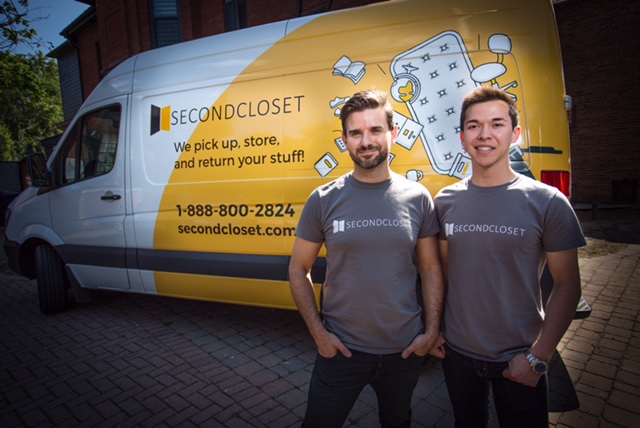
michel hyatt and Second Closet
Bolt Logistics (Second Closet) CEO Mark Ang with investor Michael Hyatt. Courtesy Bolt Logistics.

Bolt plans to expand to California and Texas in the first quarter of next year, and hopes to scale to more cities south of the border quickly.

The third-party logistics market that Bolt operates in is a lucrative one. It has a total global market value of more than $8.6 trillion USD, with the United States boasting a market size of $196.4 billion USD.

But the American market is also highly competitive, including major incumbents and new players like Menlo Ventures-backed ShipBob. But Ang is not deterred; he feels Bolt has built an easily-portable offering that has been proven in Canada, and is now ready to scale in the United States.

To prepare for that scale, Bolt has built out its executive suite, recently bringing on former Indigo and Walmart leader Jonathan Rosemberg as COO. Rosemberg is leading Bolt’s United States expansion plans. The newly expanded executive team also includes Adam Long as chief people officer, who brings experience from Amazon Canada. Bolt is also growing its senior leadership team, adding Kristy Bates as vice president of sales. Bates comes from Clearco and brings experience from Uber, ​​Entertainment, and Effem Foods (Mars Canada).

RELATED: Callia secures $6.4 million to move beyond flower delivery, fuel North American expansion

Another differentiator between Bolt and incumbents is the startup’s approach to fulfillment and last-mile logistics.

In addition to offering an end-to-end tech platform, Bolt wants to build a sustainable logistics company, in an industry known for its heavy impact on the environment. Bolt is working to become carbon negative by 2023 by bringing a fleet of electric trucks to roads and emphasizing sustainable packaging. The environmental focus is also one for Chicago-based ShipBob.

That sustainable approach is what attracted Ikea to Bolt, at least in part. Krister Mattson, managing director of Ingka Investments, stated Bolt’s zero-emission plans will contribute to Ikea’s own goal of reaching 100 percent zero-emission home deliveries by 2025.

Highlighting Bolt’s tech and sustainability-focused approach to third-party logistics, Hyatt noted, “Mark [Ang, CEO] represents the next generation of CEOs, and Bolt represents the next generation of logistics.”

Feature image courtesy Bolt Logistics

Kensington Venture Fund II invests in Deep Genomics

Deep Genomics has secured $226 million CAD ($180 million USD) as the startup has increased the number of drug candidates it has discovered using artificial intelligence (AI) and is eyeing clinic trials.The financing was led by SoftBank Vision Fund 2 and marks one of the largest rounds raised by a Canadian artificial intelligence startup, putting Deep Genomics alongside the likes of Element AI and Clio. The round brings Deep Genomics total funding to date to around $302 million CAD.

“In 2019, we got the AI to work…and the last year and a half it’s been about scaling it up, just ready to go all out.”

The startup has significantly increased the number of drug candidates it has discovered using AI since it was the first in the world to ​​use the technology to discover a drug candidate in 2019. Currently, Deep Genomics has 10 AI-discovered drug programs in its pipeline for 10 different diseases and is moving towards having those programs in clinical trials in the next couple of years.
“These are programs that would not exist without our unique AI capabilities,” said Brendan Frey, founder and CEO of Deep Genomics, who noted the startup expects to have another 30 drug programs by the end of 2022.

“It’s all about scaling up now,” the CEO said in an interview. “In 2019, we got the AI to work, proved it with the Wilson disease, and the last year and a half it’s been about scaling it up, just ready to go all out.”

The Series C round also included new investors Canadian Pension Plan Investment Board and Fidelity Management & Research Company LLC, as well as return investors, True Ventures, Amplitude Ventures, Khosla Ventures, and Magnetic Ventures. The $226 million is all equity capital, though the deal included a secondary component. Frey declined to share details about which investors were bought out, but noted it was less than $10 million.

As part of the round, Elena Viboch, the investment director at Softbank Investment Advisers, is joining Deep Genomics’ board of directors.

RELATED: Cyclica secures $23 million as it looks to create “the future biotech pipeline”

Deep Genomics has developed a platform that uses deep learning-based technology to help geneticists, chemists, and molecular biologists create drug therapies. Its software system searches across billions of molecules and pinpoints compounds that can be used to alter the composition of cells. The company states it “​​uses AI and machine learning to program and prioritize the most effective and safe RNA therapeutics for genetic diseases.”

Ribonucleic acid (RNA) is a molecule similar to DNA that converts and carries instructions for making proteins – part of the drug discovery process. RNA therapies, which Deep Genomics focuses on, can be programmed to precisely target genetic causes.

“The idea of using RNA to develop therapeutics, it’s been around for some time and, really, the promise is that it lets you treat diseases directly and it lets you develop precise drugs,” said Viboch, who worked in the pharmaceutical and biotech space prior to SoftBank.

Viboch pointed to Deep Genomics’s proprietary AI platform as one of the main reasons SoftBank invested in the startup and called Frey and his team pioneers in the field of combining machine learning, software engineering, and genomics.

Deep Genomics ​​made its first-ever discovery of a disease treatment and drug candidate using AI in 2019, a notable feat for the six-year-old company as it beat out other companies, including pharmaceutical giants, working towards the same goal.

Deep Genomics team circa 2019.

Over the past few years, the use of AI in drug discovery has become prominent in the pharmaceutical space. One report shows the increase in the use of AI by pharmaceutical companies has led to a market size that’s grown from $200 million USD in 2015 to $700 million in 2018, and is expected to increase to $5 billion by 2024.

Deep Genomics is among a number of startups operating in the AI drug discovery space. The group includes Atomwise, which was born out of the University of Toronto’s incubator, and United Kingdom-based Exscientia, which also recently secured financing from SoftBank as part of a $525 million USD deal. The field also includes Google subsidiary DeepMind, which has developed software that generates 3D models of proteins​.​

“Where Deep Genomics really, particularly shines is that their AI program can program RNA therapy for almost any gene, in any genetic position,” said Viboch.

“[Deep Genomics has] really hit our stride,” said Frey, claiming that since identifying the Wilson diseases therapy the startup has become a “well-oiled machine.”

Over the next two years, Deep Genomics expects to evaluate more than 100 different genes in its wet lab, with the exception that it will add 30 therapeutic programs to its pre-clinical trials, with an additional 80 patents. The company expects to tests its first drug therapy in humans this fall.

The company is also working with BioMarin Pharmaceutical to identify drug candidates in four rare diseases. It’s partnerships like these that sustain Deep Genomics as it works towards the commercialization of its drugs, which it expects to hit by 2028.

Images courtesy Deep Genomics

BC Tech Fund Managed by Kensington Capital Invests in Commit

Commit, a Vancouver, Canada-based startup that has a unique approach to matching up engineers looking for a new job to early-stage startups that want to hire them, today announced that it has raised a $6 million seed round. Accomplice led the round, with participation from Kensington Capital Partners, Inovia and Garage Capital.

The company, which focuses on working with remote-first startups, launched in 2019, with co-founders Greg Gunn (CEO) and Beier Cai (CTO), who met as early employees at Hootsuite, bootstrapping the company while they worked out the details of how they wanted Commit to work.

“I was an EIR [at Inovia Capital] and I just saw all these amazing founders that were coming in with world-changing ideas. They raised money, but their biggest challenge was getting an engineer to join them,” Gunn explained.

Beier Cai, co-founder & CTO, Greg Gunn, co-founder & CEO, Tiffany Jung, VP, Strategy & Ops Image Credits: Commit

In his experience, founders typically look for senior full-stack tech leads to join their company, but it’s exactly those senior engineers that are often already in very comfortable roles at larger companies and taking a bet on an early-stage startup — or even a succession of early-stage startups — is often not the most pragmatic choice for them.

After talking to dozens of engineers, the founders realized that many didn’t want to lose the support network they had built inside their current company, both from fellow engineers but also the kind of institutional support you get through formal and informal mentorship and personal development opportunities that most large tech companies offer. In addition, as Gunn noted, “hiring at early-stage startups sucks.” Senior engineers don’t want to have to go through a bunch of technical interviews anymore that test their whiteboarding skills but say very little about their actual capabilities as an engineer.

So the team decided to figure out ways to remove these barriers. Like a VC firm, it vets the startups and startup founders it works with, so the engineers that come to Commit know that these are serious companies with at least some prospect of raising funding and allowing their engineers to shape their trajectory and grow into what is potentially an early leadership role.

Meanwhile, it vets the engineers by giving them a technical interview so they can get started without having to do another one for every interview with the companies that partner with Commit. As Gunn noted, so far, the average engineer Commit has worked with only met 1.6 vetted founders before they started a pilot project together.

To mitigate some of the fiscal risks of leaving a large tech company, Commit actually pays the engineers it works with a salary until they find a job. Currently, around 90% of the engineers that start pilot projects with their prospective employees end up in full-time employment.

Image Credits: Commit

In addition to matching up founders and engineers, it also offers its community members access to an active remote-first community of fellow engineers for peer support and career advice, as well as coaching and other transition services.

In the backend, Commit uses a lot of data to match founders and engineers, but Gunn noted that while the team is very selective and has a tight profile for the people it partners with, it is committed to building a diverse pool of founders and engineers. “The thing we’re combating is the fact that these opportunities have been unevenly distributed,” he said. “Even within the Valley […] you have to be from a socio-economic class to even have access to those opportunities. For us, our whole business model is live where you want to live, but then get access to whatever opportunities you have.” Later this year, Commit plans to launch a project that specifically focuses on hiring diversity.

Commit’s startup partners currently include Patch, Plastiq, Dapper Labs, Relay, Certn, Procurify, Scope Security, Praisidio, Planworth, Georgian Partners and Lo3 Energy. The team started out slowly, working with fewer than 100 engineers so far, but hopes to expand its community to 10,000 engineers within the next 12 months. Starting today, engineers who want to join the program can get on Commit’s waitlist.

Kensington Private Equity Fund Announces New Distribution

TORONTO, April 26, 2021 /CNW/ – Kensington Capital Advisors Inc. is pleased to announce a distribution to Unitholders of Kensington Private Equity Fund of $1.12 per Unit, for a total distribution of $34.1 million, representing 3.6% of the Fund’s current Net Asset Value (NAV). The distribution will be paid on April 27, 2021 to Unitholders of record on April 26, 2021.

The current distribution reflects the continuing strong performance of the Kensington Private Equity Fund. Prior to the distribution, the value of the Fund’s units has increased by approximately 12.5% since the beginning of 2021. The current distribution marks the Fund’s eleventh consecutive year of profit distributions to Unitholders.

“During these unprecedented times, the diversification of the portfolio continues to prove its strength,” said Kensington Chairman, Tom Kennedy.

“The entire team remains focused and continue to initiate and execute transactions that enhance the resiliency and sustainability of the portfolio during this challenging period.”

The Kensington Private Equity Fund is a pooled investment vehicle formed to provide qualified investors with an effective way to invest in the private equity markets. Private equity is an alternative asset class with low correlation to the public markets. Kensington manages the Private Equity Fund to minimize risk through diversification and capture upside through active management. The Fund’s performance and portfolio highlights are published on the Kensington website (kensington-capital.flywheelstaging.com), and the Fund’s Units are available on FundSERV.

About Kensington:

Founded in 1996, Kensington Capital Partners Limited (“Kensington”) is an employee-owned, high performing alternative investment firm with offices in Toronto, Vancouver, and Calgary. Our purpose is to build great businesses, and in doing so, create top-performing investment solutions for our investors. We invest in a portfolio of innovative direct and fund investments through diversified funds focused on private equity, venture capital, and hedge funds. As of April 2021, Kensington has assets under management of $1.7 billion, managed across several active funds.